1. Introduction
1.1 The importance of oral health
Good oral health is an essential part of general health and wellbeing. Deciduous teeth (sometimes referred to as baby, first, primary, or milk teeth), play an important role in early development. They help children learn to eat and speak properly, and they guide the alignment and eruption of permanent (adult) teeth. Establishing healthy oral habits in childhood sets the foundation for great habits that last a lifetime.
Despite its importance, oral health is often overlooked. Many children continue to suffer unnecessarily from the pain and complications caused by preventable oral diseases:
- Tooth decay is the most common chronic disease in childhood (Do & Spencer, 2016).
- Dental admissions are the second highest cause of preventable hospital admissions in children under five years old (Australian Institute of Health and Welfare, 2020).
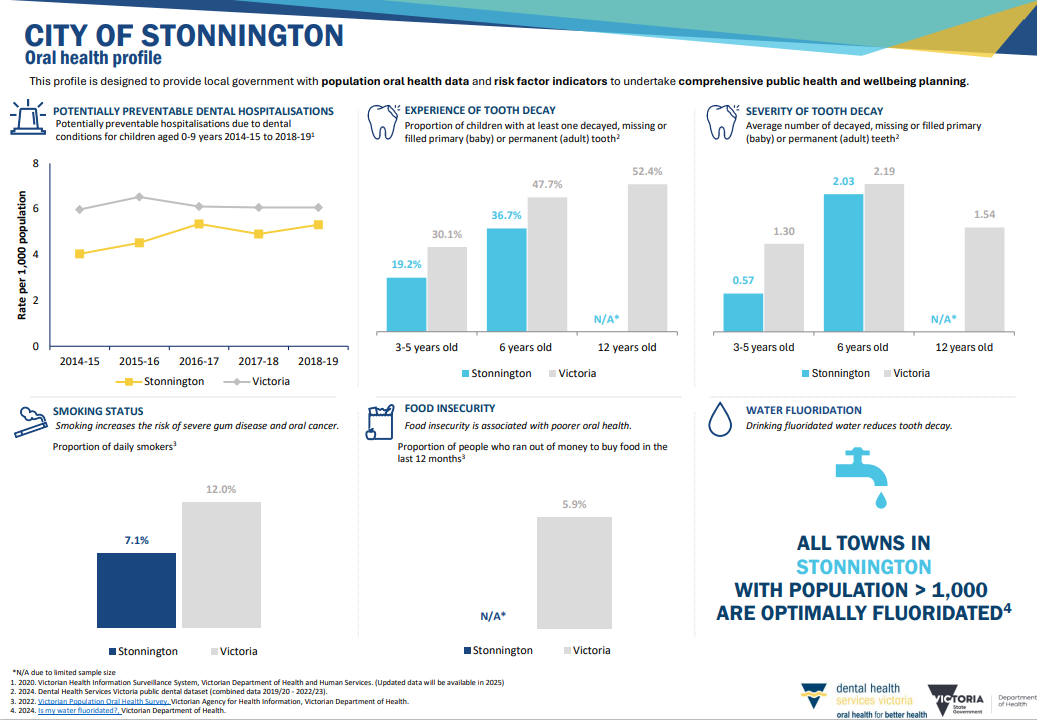
- Data from public dental clinics shows that 30 per cent of three-to-five-year-old children have experienced dental caries (Dental Health Services Victoria 2024).
- Data from 2014-2015 showed 57 percent of children attending preschools in some high-risk areas had a history of dental caries in their deciduous teeth (Graesser et. al, 2022).
 Every child is at risk of developing tooth decay, but some groups of children are more vulnerable than others. Children from lower socio-economic backgrounds, culturally and linguistically diverse communities, First Nation peoples, and those living in rural communities face higher risk. Limited access to fluoridated water also contributes to significantly higher rates of dental caries in affected communities (Do, 2020).
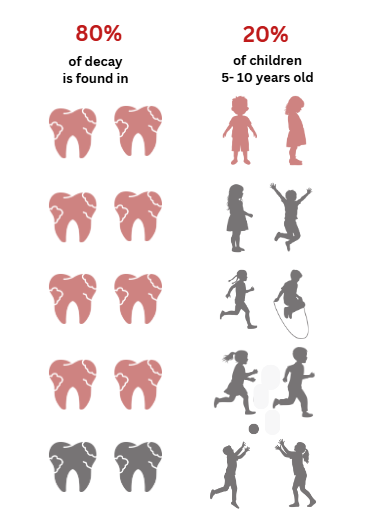
As a result, the burden of dental disease is not shared equally. Dental caries is a disease of disadvantage, with 20 percent of Australian children aged 5 to 10 years accounting for 80 percent of the decay in that age group (Do & Spencer, 2016). This indicates that many of these children are living with multiple decayed teeth.
The impact of tooth decay, even on one tooth, can extend beyond oral health, affecting a child’s ability to eat, sleep, concentrate, and participate in daily life. In some cases, untreated decay can lead to infections and may require hospital-based treatment that could have been avoided with earlier intervention.
There is increasing evidence of links between poor oral health and a range of health conditions. These include cardiovascular disease, diabetes, respiratory diseases, kidney disease, peripheral vascular disease, dementia, adverse pregnancy outcomes, aspiration pneumonia, and obesity. Taking care of teeth from an early age is therefore important not only for maintaining oral health, but also for supporting overall health and wellbeing throughout life.
The good news is that dental decay is largely preventable. Maternal and Child Health (MCH) nurses are uniquely positioned to help in the prevention of oral disease because they have regular, trusted contact with families during a child’s critical early years. They are also well-placed to connect families with local dental services, ensuring children receive the care and support they need early.
1.2 Oral health policy context
Healthy mouths, healthy lives – Australia’s National Oral Health Plan 2015–2024
The National Oral Health Plan 2015–2024 had two national goals. Firstly, to improve the oral health status of Australians by reducing the incidence, prevalence, and effects of oral disease; and secondly, to reduce inequalities in oral health status across the Australian population.
It recognises the importance of MCH nurses as playing a significant role in oral health promotion, providing dietary advice, and implementing non-invasive disease prevention strategies.
The Federal Department of Health and Aged Care is currently developing the next National Oral Health Plan for 2025–2034. For the most current information and updates, please refer to the Department’s website.
Victorian Action plan to Prevent Oral Disease 2020-30
Oral Health is a priority of the Victorian Department of Health.
Aligned with the national oral health plan, the Victorian Action Plan to Prevent Oral Disease 2020-30 aims to achieve good oral health for all Victorians by 2030, focusing on reducing the oral health disparity for those at greater risk of oral disease.
This is to be achieved through four action areas:
- Priority 1: Improve the oral health of children
- Priority 2: Promote healthy environments
- Priority 3: Improve oral health literacy
- Priority 4: Improve oral health promotion, screening, early detection and prevention services
MCH nurses are well placed to promote oral health, screen, detect, and refer identified oral health issues in preschool aged children. They are also specifically referred to as a prevention service under Priority 4.
1.3 Maternal and Child Health Service policy context
The Maternal and Child Health Service is a free, universal primary health service available to all Victorian families with children from birth to school age. The service is delivered through a partnership between local government (represented by the MAV), health services, Aboriginal Community Controlled Organisations (ACCOs), and the Department of Health. Its purpose is to promote and strengthen health, wellbeing, safety, development, and learning outcomes for children and their families, including culturally safe and responsive care for Aboriginal families.
Following more than a decade of collaboration, the relationship between Oral Health Victoria (OHV) and the Maternal and Child Health Service was formalised with the creation of the Maternal and Child Health Practice Guidelines in 2009. These guidelines were written to support the revised Key Ages and Stages framework.
KAS visit
| Oral health actions stated in the Maternal and Child Health Service Practice Guidelines 2009 | |
|---|---|---|
8 months | Mouth check (lift the lip) Oral health education Discuss key messages on Tooth Tips 0-12mths * | |
12 months | Oral health education Discuss key messages on Tooth Tips 12-18 months* | |
18 Months | Mouth check (lift the lip) Toothbrushing demonstration Oral health education | |
2 years (24 months) | Mouth check (lift the lip) | |
3.5 years (40 months) | Mouth check (lift the lip) | |
* distributed via Better Health Channel (BHC), MCH app, or printed hardcopy.
During these Key Age and Stages (KAS) visits, the MCH Nurse performs an oral health assessment or mouth check using the ‘Lift the Lip’ principles at the 8-month, 18-month, 2-year and 3.5-year consultations.
To support MCH nurses in oral health education, age-appropriate Tooth Tips resources are available for carers. These resources cover key oral health information, and are provided as a part of the following key ages and stages consultations:
- eight-month consultation – tooth tips for 0-12 months
- twelve-month consultation – tooth tips for 12-18 months
- eighteen-month consultation – tooth tips for 18 months - 6 years
OHV continues to develop resources and seek opportunities to support MCH nurses in promoting oral health during early childhood. The partnership ensures MCH nurses have access to practical tools and information that assist with delivering oral health education and guidance during consultations.
See references for '1. Introduction'
Publication date: March 2026.