4. Maintaining good oral health
4.1 Oral health messages for families
Early childhood is a key time for forming lifelong healthy habits, laying the foundation for good health into the future. As children grow and encounter new experiences, they develop new behaviours and skills. Families play a vital role in shaping these early behaviours, which often continue into adulthood.
The following family-friendly messages are designed to help motivate families to create healthy habits that support their children's wellbeing.
General oral health messages for families

- Baby teeth help hold the space for adult teeth to come through.
- Looking after children's teeth now teaches them the habits for good health in adulthood.
- Healthy baby teeth play an important role in allowing children to eat, speak and socialise.
- Take care of teeth as soon as they appear.
Tap water and milk are the best drinks. Limit fruit juice and sugary drinks, particularly between meals.
- Water keeps children hydrated and helps fuel their minds and bodies, so they can learn and play.
- Drink companies spend a lot of money on marketing to make sugary drinks appealing. Children will happily drink tap water, given the chance.
- Fluoride is a natural mineral that helps keep teeth strong and is found in most tap water around Victoria.
Choose nourishing foods and limit sugary snacks
- Choose foods from all five food groups - fruit, vegetables, grains, protein foods and dairy foods (or alternatives).
- Give your children the opportunity to try a broad range of nourishing foods. It often takes 10-15+ tries for a child to warm to a new food.
- Food companies heavily promote packaged unhealthy snacks for lunchboxes through deceptive marketing. Seasonal fruits and vegetables are better options and usually better value too.
- Influencers and the media have created unrealistic expectations about healthy lunchboxes, making them seem complicated. Start by swapping out one packaged snack for fruit or vegetables. Gradually add in more fresh produce, dairy foods and protein foods.
Brush teeth twice a day (from 18 months use low fluoride toothpaste to prevent tooth decay).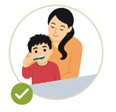
- Brushing teeth twice a day- in the morning and at night before bed- helps teeth stay strong.
- It's normal for some children to not enjoy brushing at some stage. Try to keep brushing fun by singing songs or letting your child play with a toy.
- Even a quick attempt at brushing is better than nothing. Consistency helps your child develop the understanding that brushing is a normal part of their daily routine.
Have your child’s teeth checked by 1 year
- It is important for children to have regular professional dental check-ups even if their teeth look healthy.
- Early dental check-ups help children become comfortable with dental care from a young age. In Victoria these appointments are either free or low cost for children up to 12 years.
See ‘Section 8– Dental services’ for more information about linking families with dental services
Oral health messages about infant feeding:
Bottle feeding
- Bedtime bottle feeding can increase the risk of tooth decay. Do not put babies and children to bed with a bottle. When children sleep, they have less saliva to protect their teeth from milk increasing the risk of tooth decay.
- Six months is a good time to help babies learn the skills of drinking and swallowing from cups
Learning to hold and drink from a cup is an important new skill that babies need to learn. Phase out the bottle by 12 months of age.
- Infant bottles should only be used for expressed breastmilk or infant formula
Breastfeeding
- Breastfeeding is a healthy choice for your child and can be continued without concern for their oral health. Focus on simple protective habits like offering tooth‑friendly foods and keeping up with regular brushing.
4.2 Toothbrushing with children
1.Small, soft bristle toothbrush
- Features: Soft bristles, small head, easy to hold handle
- This is the standard option for cleaning children’s teeth. It is widely recommended due to its effectiveness and accessibility. We encourage you to suggest this as the first choice for most families.
2. Low fluoride toothpaste (from 18 months until 6 years of age)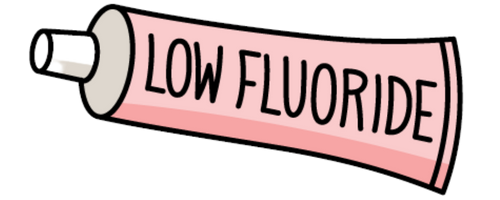
- Look for a toothpaste labelled low fluoride.
- Warn families that there are also non-fluoride toothpastes available that do not offer the same benefits as fluoride toothpaste.
From 6 years old, children should use full-strength fluoride toothpaste.
Toothbrushing flyers
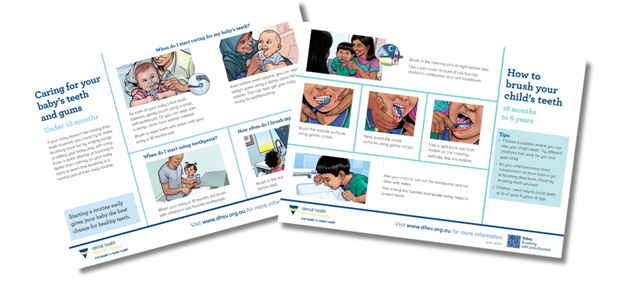
OHV’s handout ‘Caring for Teeth and Gums 0–6 years’ is available in 19 languages, to help families care for their child’s oral health from the first tooth. It includes sections for infants (0–18 months) and young children (18 months to 6 years).
Caring for teeth and gums 0-6 (click here for pdf)
Toothbrushing videos
OHV has also created short toothbrushing videos, available in 19 languages and divided into two age groups: 0–18 months and 18 months–6 years. These videos show correct brushing techniques and offer practical tips to make toothbrushing easier and more engaging for young children.
Toothbrushing with your baby (0 - 18 months) in 19 languages
Toothbrushing with your toddler or pre-schooler (18 months - 6 years) in 19 languages
Alternative option, typically for children 3 years and older: Electric Oscillating-Rotating Toothbrush
These are effective when used correctly, but they are not necessary for everyone. It is important that families know that children still need support to brush their teeth when using an electric toothbrush. Please encourage families to follow manufacturer’s instructions on appropriate age for use of each product.
See our How to brush with an electric toothbrush resource for more information on the correct technique.
Note: If you are sharing this resource with families, please remind them to use low‑fluoride toothpaste for children aged 18 months to 6 years, as the original resource was developed with adults in mind.
Other products marketed to families
Families may feel tempted to buy products that promise convenience or use marketing to suggest they are superior or easier. However, research indicates that options like:
- silicone finger brushes,
- and U-shaped “automatic” brushes
are either less effective or lack sufficient evidence of effectiveness in children.
While standard soft bristled toothbrushes are effective and are the general recommendation, dental practitioners may recommend alternative products for some children with a disability.
NSW Health - Oral health advice for carers of people with a disability
NSW Health has helpful resources for carers of children with a disability.
How to care for your child's oral health
Paediatric Dentistry University of Leeds- Advice and support for families of young autistic children to care for their teeth
4.3 How to provide a toothbrushing demonstration
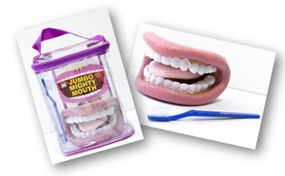
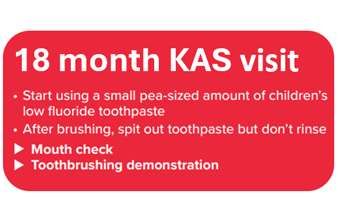
At the 18-month Key Age and Stage visit, MCH nurses conduct a toothbrushing demonstration. This is an important opportunity, as some families may be unaware of the correct technique for brushing their child’s teeth. Each location should have a mouth model and toothbrush available to assist with the demonstration.
This visit is also a key time to advise families to start using a low-fluoride children’s toothpaste.
What to cover in a toothbrushing demonstration
- Children need help brushing their teeth until they are about 8 years old
Most children do not have the manual dexterity or focus needed to brush effectively until they are about 8 years of age. In addition, children may need reminders and prompts to achieve twice daily brushing.
For these reasons, children need an adult to help them brush their teeth until they can do it well by themselves. This might look like taking turns, observing and coaching to make sure all surfaces have been covered.
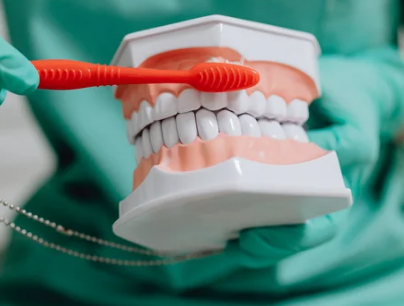
- Brush in small circles at a 45-degree angle
Demonstrate to families the correct angle for placing the toothbrush and the motion to use while brushing. It can be helpful for some people to see this technique demonstrated to understand the correct method.
- Brush all surfaces of the teeth
Remind families to brush all surfaces of the teeth, including the back teeth where food can get stuck in the grooves. Don’t forget the gum line where plaque can build up, and the back of the front teeth.
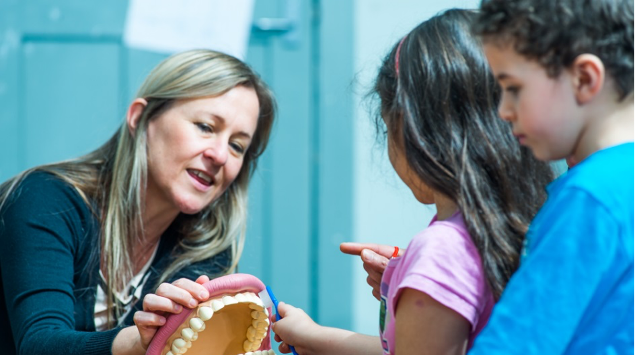 Introduce a low fluoride toothpaste from 18 months
 Advise families to start using a low-fluoride children’s toothpaste at this stage. Remind them that fluoride is essential for strengthening and protecting growing teeth.
For more information see 'Section 9 - Fluoride’
- Encourage children to spit out toothpaste and avoid rinsing with water
The fluoride in the toothpaste helps to strengthen teeth and should remain on the teeth after brushing. Avoid rinsing, eating, or drinking immediately after brushing where possible.
Tip to help young children learn to spit out toothpaste:
Encourage families to let children practise spitting into a cup or sink without toothpaste. This helps them become familiar with the spitting action before adding toothpaste to the routine.
- Create a lifelong habit: brush twice a day
Starting the habit of brushing twice a day as soon as a child's first tooth appears can set the foundation for lifelong good oral health. While children may sometimes resist brushing, it's important for families to remain consistent.
4.4 Tooth friendly snacks and nutrition
The role of sugar in tooth decay
As outlined in 'Section 3 - Tooth decay: Understanding the process’, without sugar, there is no tooth decay. Sugar is in a lot of the foods we eat every day.
Fermentable carbohydrates
Carbohydrates are a nutrient found in food, an important source of energy for our bodies. Fermentable carbohydrate are a type of carbohydrate that can be broken down by bacteria in the mouth to produce acid that may contribute to tooth decay. Other carbohydrates don’t break down until they move further down the digestive tract.
Fermentable carbohydrates include not only sweet foods but also carbohydrate-rich staples like bread, rice and pasta. As we chew, these foods start to be broken down into sugars in our mouths. That does not mean families should stop providing these staple foods to children to avoid decay. These foods contain important nutrients for our bodies and our mouths, and not all sugars are equally as likely to cause tooth decay.
Refined starch
Refined starches are processed carbohydrates that have been stripped of fibre and other nutrients. They are rapidly digestible and can quickly break down into sugars in the mouth. Examples include white bread, crackers, and processed cereals.
Free sugars: the highest risk group
Free sugars are the most likely to cause tooth decay because they are easy for bacterial plaque to feed on and produce acids. Free sugars are:
- Sugars added to foods and drinks by manufacturers, cooks or consumers
- Naturally occurring sugars in honey, syrups, fruit juices and fruit purees
Foods and drinks containing free sugars should be limited, especially between meals. If consumed, they are best eaten at mealtimes.
Why snacking habits matter
When it comes to tooth decay, not only does the type of sugar matter, but also how often teeth are exposed to sugars.
Snacking is a normal part of children’s routines. However, frequent snacking - especially on foods high in free sugars or refined starches - can increase the risk of tooth decay.
Each time a child eats fermentable carbohydrates, bacteria in the mouth produce acids that soften the surface of the teeth. If the child snacks frequently, there may not be enough time for the teeth to recover between acid exposures.
For more on this process, refer to 'Section 3.5- Frequency of snacking and exposure to sugars: The Stephan Curve’
Guidelines for tooth friendly snacking habits
- By the age of 12 months, families are encouraged to provide 3 meals and 2-3 snacks and have children avoid grazing between these times.
- Encourage families to allow a 1 ½ hour break between each meal and snack, so the teeth can remineralise .
- If snacks are part of the routine, limit them to regular times to avoid grazing.
- Choose snacks that are low in sugar and highly refined starch (e.g. white bread/pasta/rice, many breakfast cereals and some crackers) - fresh fruit and vegetables and dairy foods (or some non-dairy alternatives) are some tooth-friendly options.
- If eating sweet foods, have them alongside a main meal rather than as a snack.
- Offer tap water with meals and snacks. Water helps to wash away food particles and bacteria after eating, and the fluoride in tap water helps to strengthen the tooth surface.
Tooth friendly snack ideas
Offer snacks that are nutritious and low in added sugar, such as:
- Fresh fruit or tinned fruit (tinned in fruit juice, not syrup)
- Vegetables – raw, cooked, canned or frozen – with or without a low-sugar dip like hummus or tzatziki
- Plain yogurt without added sugar
- Cheese and wholegrain crackers
- Wholemeal or wholegrain sandwiches or wraps
- Wholegrain dry crackers
Foods to limit, especially at snack times
Examples of foods and drinks high in free sugars or refined starches include:
- Sweetened breakfast cereals and snack bars
- Fruit strips and muesli bars
- Lollies, chocolate, cakes and biscuits
- Sweet spreads like jam, honey and choc-hazelnut spread
- Ice cream and flavoured yoghurts
- Fruit juice, cordial and soft drinks
- Flavoured milks
- Savoury processed foods such as chips, sausage rolls and meat pies
- Pouched foods, especially fruit-based purees
If sweet foods are offered, it is best to include them with a main meal rather than serving them on their own as a snack.
Choose whole fruit over fruit juice
While fruit juice has useful nutrients, it is also high in free sugars. A child is unlikely to eat four whole oranges but could quite easily drink the sugar from four oranges as one glass of orange juice. Eating whole fruits and vegetables is the best choice for teeth because they also contain nutrients essential to good overall and oral health.
Plain dairy is good for children’s teeth
Plain milk, unflavoured yoghurt, cheese (and/or suitable calcium-rich alternatives) provide calcium and other minerals which are good for teeth. Avoid flavoured milks and yoghurts which can contain free sugars.
Nutrition and healthy tooth development
A balanced diet supports not only general health but also the development of strong, healthy teeth. Important nutrients include:
- Calcium, which strengthens the teeth and jawbones
- Phosphorus, which works with calcium to build hard tooth structure
- Vitamin D, which helps the body absorb and regulate calcium and phosphorus
Low levels of vitamin D in children or pregnant women may affect how well children’s teeth form, increasing the risk of decay and fractures. A healthy diet is essential for healthy teeth.
4.5 Resources to support age-based advice and anticipatory guidance in the key ages and stages visits
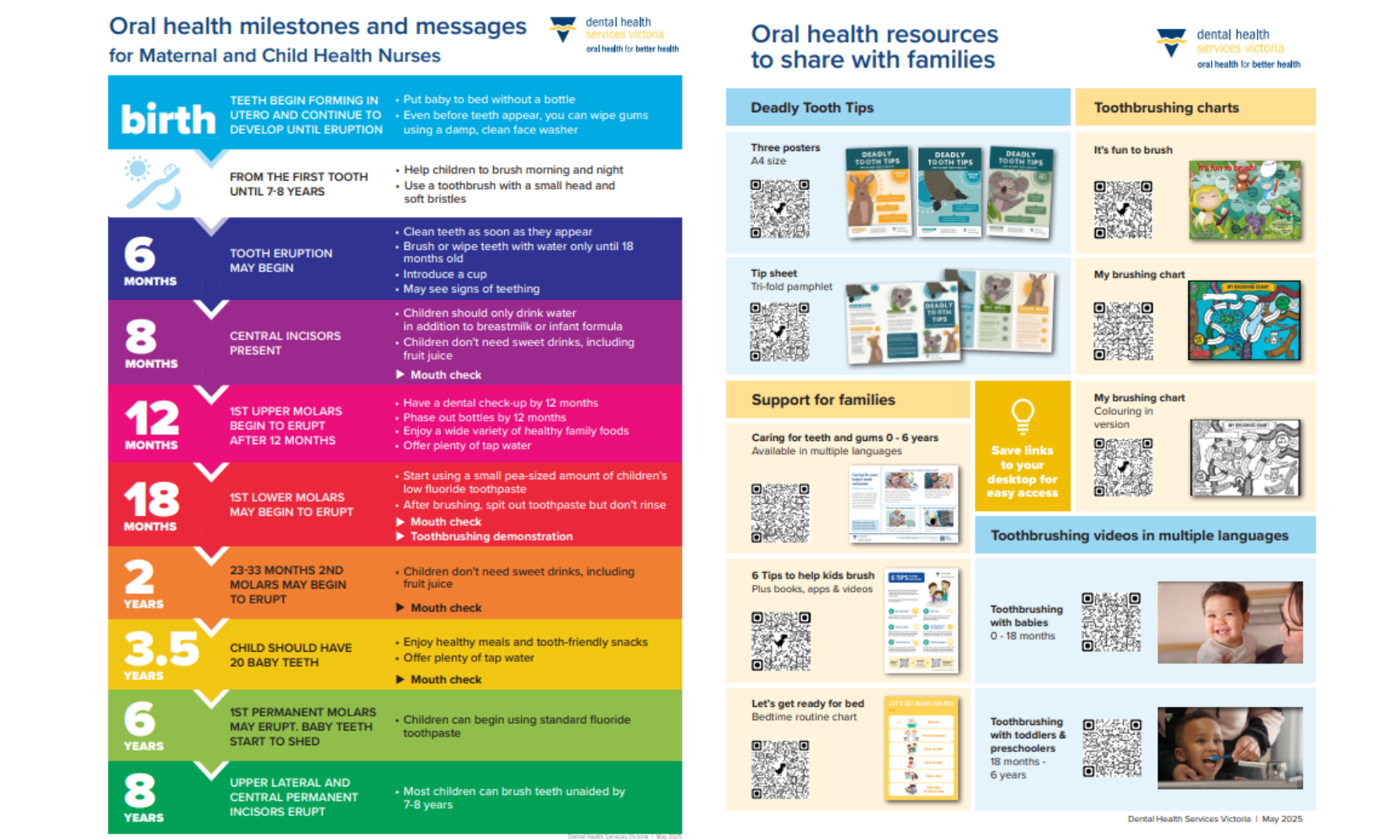
Oral Health Milestones and Key Messages
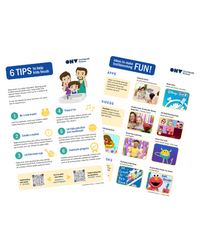
This quick guide highlights key oral health milestones and messages to share with families at each Key Age and Stage visit. A double-sided version with QR codes linking to family resources is also available for use during visits. (Note: this resource is not designed to be given to families to take home.)
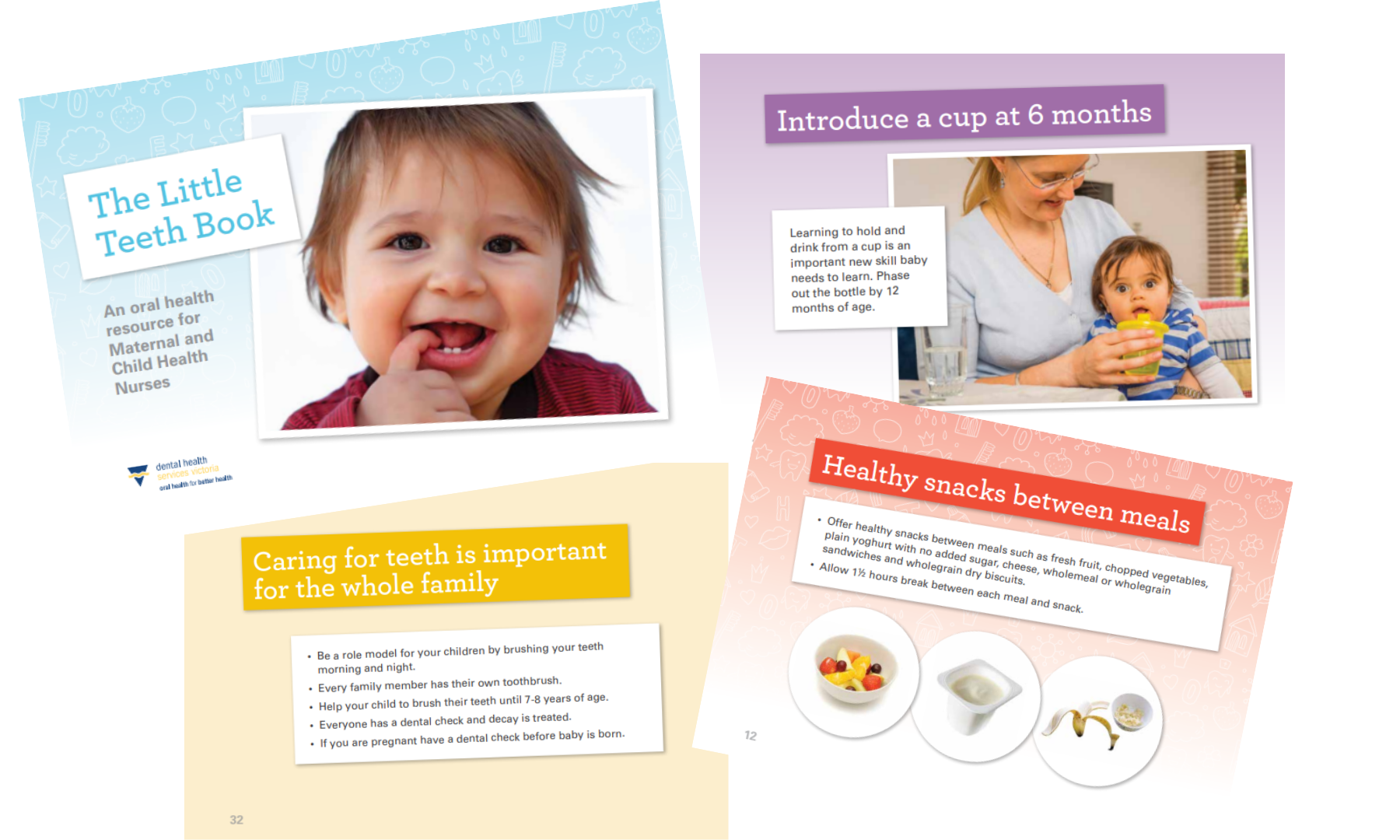
The Little Teeth Book
The Little Teeth Book is designed to support MCH nurses to talk about oral health with families. It provides simple image-based messages, and can support you with:
- Anticipatory guidance
- A concern you would like to address
- A response to a question raised by a family
The messages are just a starting point for a discussion in which you can provide more detailed information based on your knowledge and experience and adapted for the context of the child and their family.
To order a copy of The Little Teeth Book contact HFHS@dhsv.org.au
4.6 Oral health and pregnancy
Pregnancy increases the risk of periodontal disease (gum disease) associated with normal hormone changes. Pregnant people may also be at higher risk of tooth decay if their diet changes (for example, if they crave sugary foods), if they experience morning sickness (vomiting exposes the teeth to acid), or if nausea makes it difficult to brush their teeth.
Research indicates a potential link between severe periodontitis in expectant mothers and an increased risk of premature birth, low birth weight, and other adverse pregnancy outcomes (Raju & Berens, 2021). However, further research is needed to determine whether treating gum disease can positively influence these outcomes (Raju & Berens, 2021).
Common signs of gum disease include:
- bleeding gums
- red gums (instead of pink)
- swollen gums
- bad breath.
During pregnancy, it is important to:
- maintain good oral hygiene practices
- maintain a low-sugar diet
- consume adequate calcium and vitamin D for optimal foetal teeth and bone development
- visit a dental practitioner
- seek dental or medical advice for prolonged vomiting, as this may lead to tooth erosion or dental caries.
Visiting a dental practitioner while pregnant is highly recommended. A regular check-up is an important routine to develop for parents and children.
Pregnant people who have a current concession card will not go on the general waiting list to see a public dental practitioner but will be given the next available appointment.
Key oral health message for pregnancy
Routine dental treatment is safe and recommended during pregnancy. Just be sure to tell your dental practitioner you are pregnant.
Refer to ‘Section 8 – Dental Services’ to learn more about eligibility and access to the public dental system
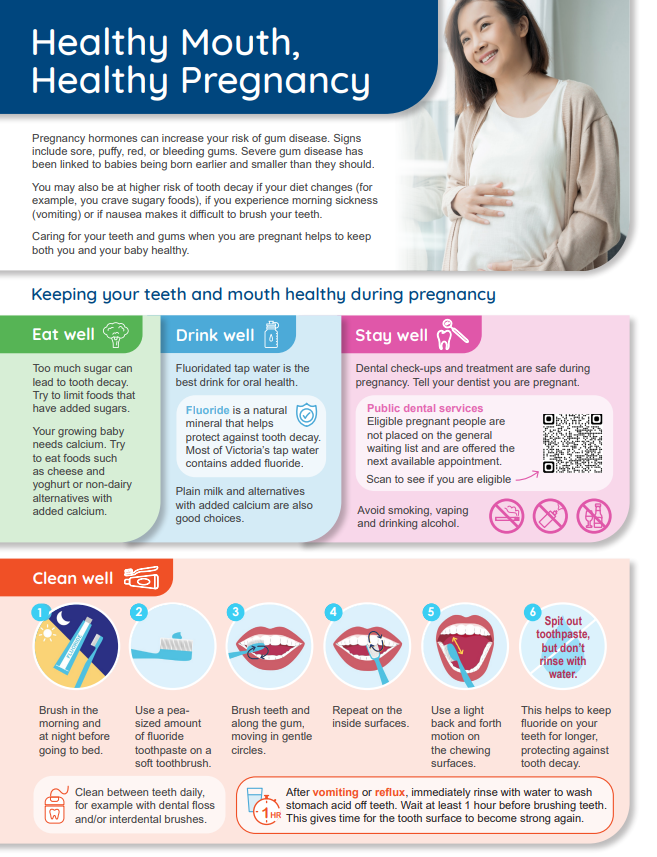
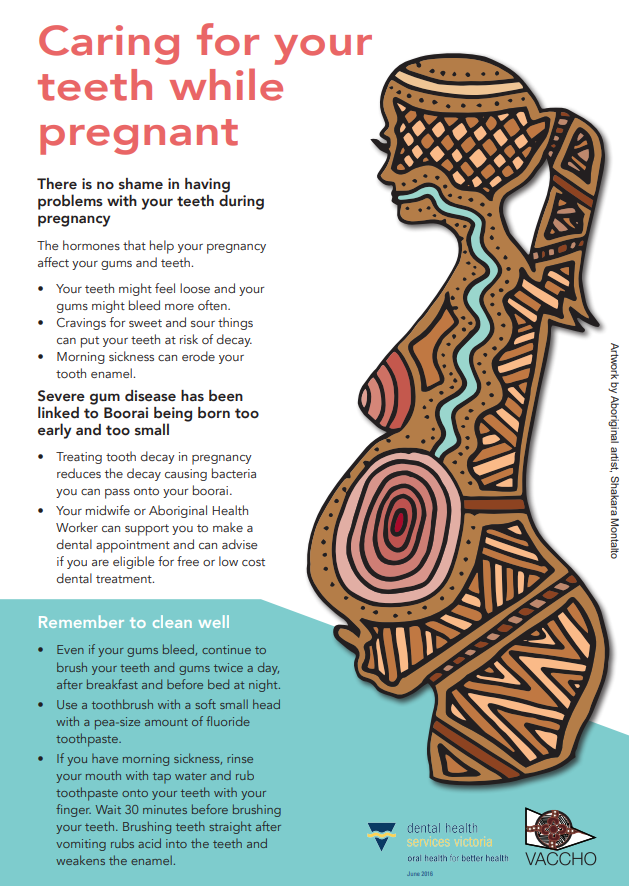
OHV has created the following resources to share with pregnant people.
4.7 Whole family oral health
When parents and caregivers maintain good oral health, it can have positive impacts on the children in that family. Oral bacteria can be transferred from person to person. For this reason, family members should avoid putting anything in their baby’s mouth if it has been in their mouth (for example carers sharing spoons or ‘cleaning’ dummies by putting them in their mouth).
Additionally, the types of foods a family eats can influence the oral microbiome, meaning diets with fewer tooth-friendly options may increase susceptibility to dental issues for both parents and children (Pitts et al.2015).
Children also pick up habits from their parents. When parents demonstrate good oral hygiene, make healthy food choices, and attend regular dental visits, children are more likely to adopt these habits themselves.
Oral health message for families
Healthy smiles are a family effort. Caring for your oral health helps protect the whole family, including your little one. Simple habits like regular brushing and having tooth-friendly foods and drinks support everyone’s wellbeing.
4.8 Breastfeeding and oral health
OHV supports breastfeeding for the first 6 to 12 months and beyond, in line with the Infant Feeding Guidelines.
Parents may hear that breastfeeding increases their baby’s risk of dental caries, however a recent systematic review showed no increased risk of early childhood caries (ECC) for children breastfed up to 24 months (Lustosa et. al, 2025).
There is no need to discourage breastfeeding for oral health. Instead, focus on promoting well-established protective factors like a non-cariogenic diet, and good oral hygiene practices.
See references for '4. Maintaining good oral health'
With thanks to Tanya Gunnion, Health Promotion Officer, (OHV) for her valuable contribution to this page.